RG Richardson Business & Economics

RG Richardson Business & Economics
Interactive financial ebooks

Kindle users get crafty as old models stop working

  Kindle users get crafty as old models stop working

Jailbreaking kindle

Niv Bavarsky

Paperback diehards who claim to love lugging around Ron Chernow doorstoppers are getting vindicated. Today, Amazon is ending support for Kindle e-readers released before 2013—which prompted some users to load up on books or alter their devices.

While the titles already loaded on the gadget your parents gifted you in 2010 aren’t going anywhere, the owners of the ~2 million older Kindles still in use won’t be able to acquire new books from the Kindle Store.

  • The change affects more than a dozen models, including some Kindle Fire tablets, the Kindle Paperwhite 1st Generation, and the Kindle Touch.
  • Amazon is offering a 20% discount on new Kindles and a $20 credit for e-book purchases to those trading in qualifying older models.

But some aren’t rushing to Amazon.com

Many scrappy bookworms are now sidestepping the Amazon ecosystem by sideloading titles onto their vintage Kindles from designated apps on their computer.

Others are altering their Kindle’s software—a more technically involved process known as jailbreaking that may violate Amazon’s terms of service (though not always the law). This allows them to install alternative reading apps with more features and download books in formats that aren’t compatible with ordinary Kindles. You can see how people are doing it here.

Many users are angry…accusing Amazon of practicing planned obsolescence and exacerbating the issue of e-waste, with some saying they’ll switch to competing e-readers. Amazon currently controls 72% of the e-reader market.

Investors are pulling away from AI on a global scale

 Investors are pulling away from AI on a global scale

Investors wary from Iran war

Spencer Platt/Getty Images

Investors around the world are dumping tech stocks like they’re toxic cast members on Love Island. Tuesday continued a global sell-off in tech that may be a sign that traders have become skittish about the long-term profitability of AI and chipmakers.

The abandoning of the AI ship began in the US on Monday before spreading to Asia yesterday and resuming in the States after the other side of the world went to sleep:

  • South Korea-based chipmakers SK Hynix and Samsung fell more than 12% yesterday, resulting in a 10% decline in the Korean Composite Stock Price Index.
  • Magnificent Seven stocks finished down 1.5% as a group yesterday, with only Microsoft and Amazon showing a gain.
  • Other US-based AI companies to take a hit included Broadcom (-3%), Micron (-13.2%), AMD (-5.8%), Intel (-6.1%), and Marvell (-9.4%).

What’s causing the sudden loss of confidence?

Much like a couple trying to decide what to have for dinner, no one has a definitive answer—but there are several plausible options.

Google/SpaceX dips: On Monday, both companies took big losses—Google dropped 5%, while SpaceX fell 16%. Some analysts believe that was enough to trigger the sector-wide selloff.

Interest rates: Most forecasters believe that the Fed will raise rates by at least a quarter-point this year. Bank of America predicted on Monday that there will be three hikes, totaling three-quarters of a point, in 2026. Higher rates could result in a deceleration of the heavy investing in AI technology that tech companies have planned in the coming years.

Spending. Investors periodically remember that they’re worried about the hundreds of billions of dollars that tech giants are investing in AI.

What’s next: JPMorgan analysts suggested that the anxiety could be related to Micron dropping its earnings report this afternoon. The chipmaker is expected to provide insight into whether the demand for AI infrastructure will remain high...or if the panic will continue.

How does the Fed work


So how does the Fed work? Glad you asked! USAFacts Founder Steve Ballmer just dropped this new video on the Fed and we couldn’t wait to share it with you. 
Join Steve as he breaks down the Federal Reserve's complex role in the American economy. He'll break down complicated concepts, provide visuals to shed light on the institution, and even make a few costume changes. 
 
This is the first Spotlight edition of the USAFacts newsletter, which we’ll send when we have a cool new way to explore data with you. You can expect to get them about once a month. 
 
Here's a preview of what you'll find in the video, plus data to understand the Fed's role in your economic well-being:  
The Federal Reserve is the most important bank you’ll never use.
  • It’s a bank for banks. It holds cash reserves, moves money between banks, and can lend to them whenever needed.

  • The Fed has five responsibilities. The one that affects you most directly is its mandate to conduct monetary policy to keep inflation in check and employment high. Through it, the Fed can influence interest rates across the entire economy. (Here are the other four.)  
Speaking of inflation
  • When the Fed lowers interest rates, it can lead to the running economy “hot.” It can make it cheaper for you to buy a house, get a car loan, or borrow money to open a business. But if money’s easier to borrow, it can fuel inflation.

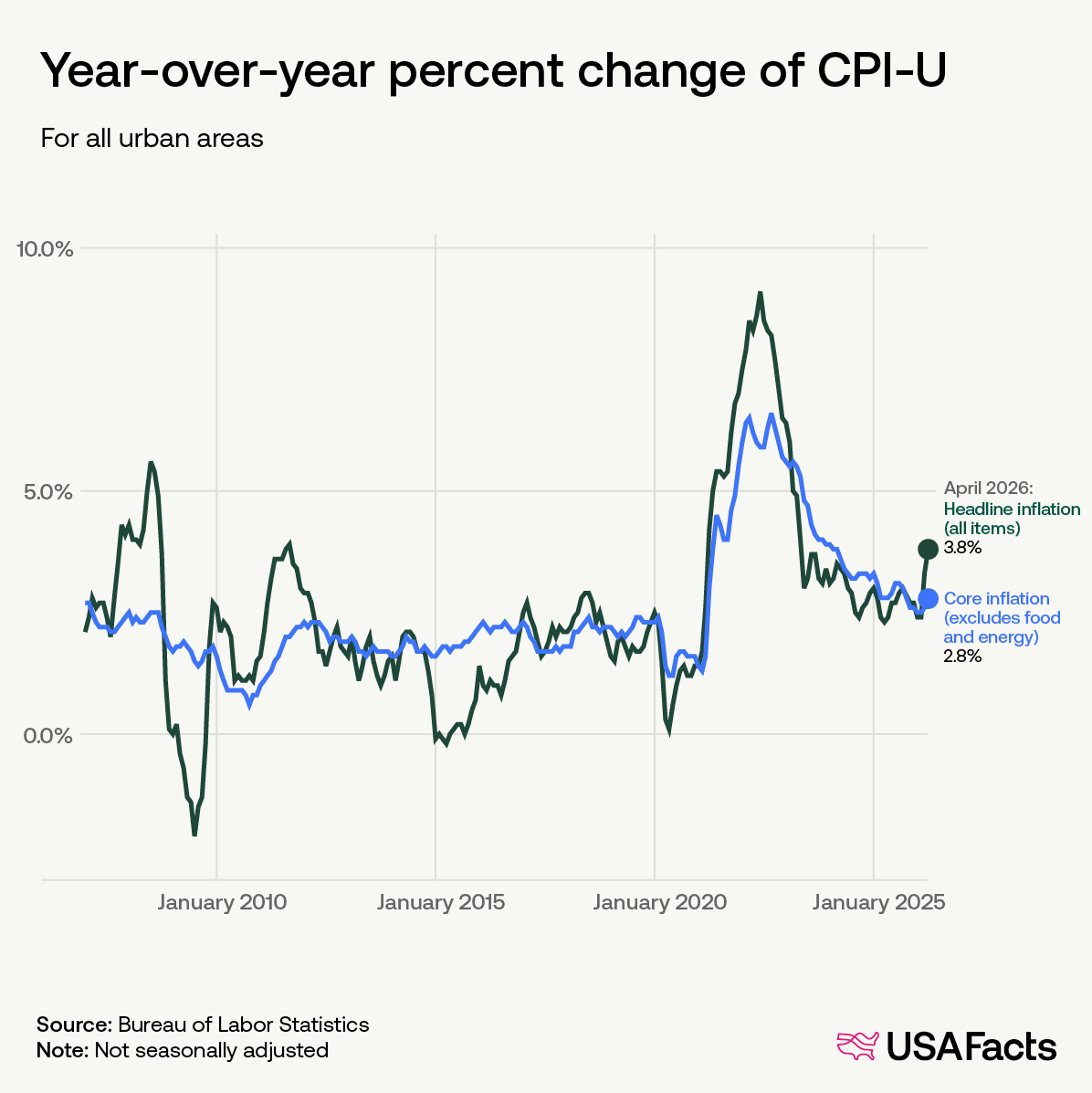
  • Last month’s inflation rate was 3.8%. The Bureau of Labor Statistics measures inflation through changes in the Consumer Price Index (CPI), a metric designed to track the price of a “basket of goods and services.” 
  • Think a dollar doesn't go as far as it used to? You're right. Track how the dollar’s value has changed with our inflation calculator! Explore the value from 1913 to now, or at any point in between.

  • Workers’ wages aren’t keeping up with inflation. Nominal wages rose 3.6% from April 2025 to April 2026, while prices grew 3.8%.

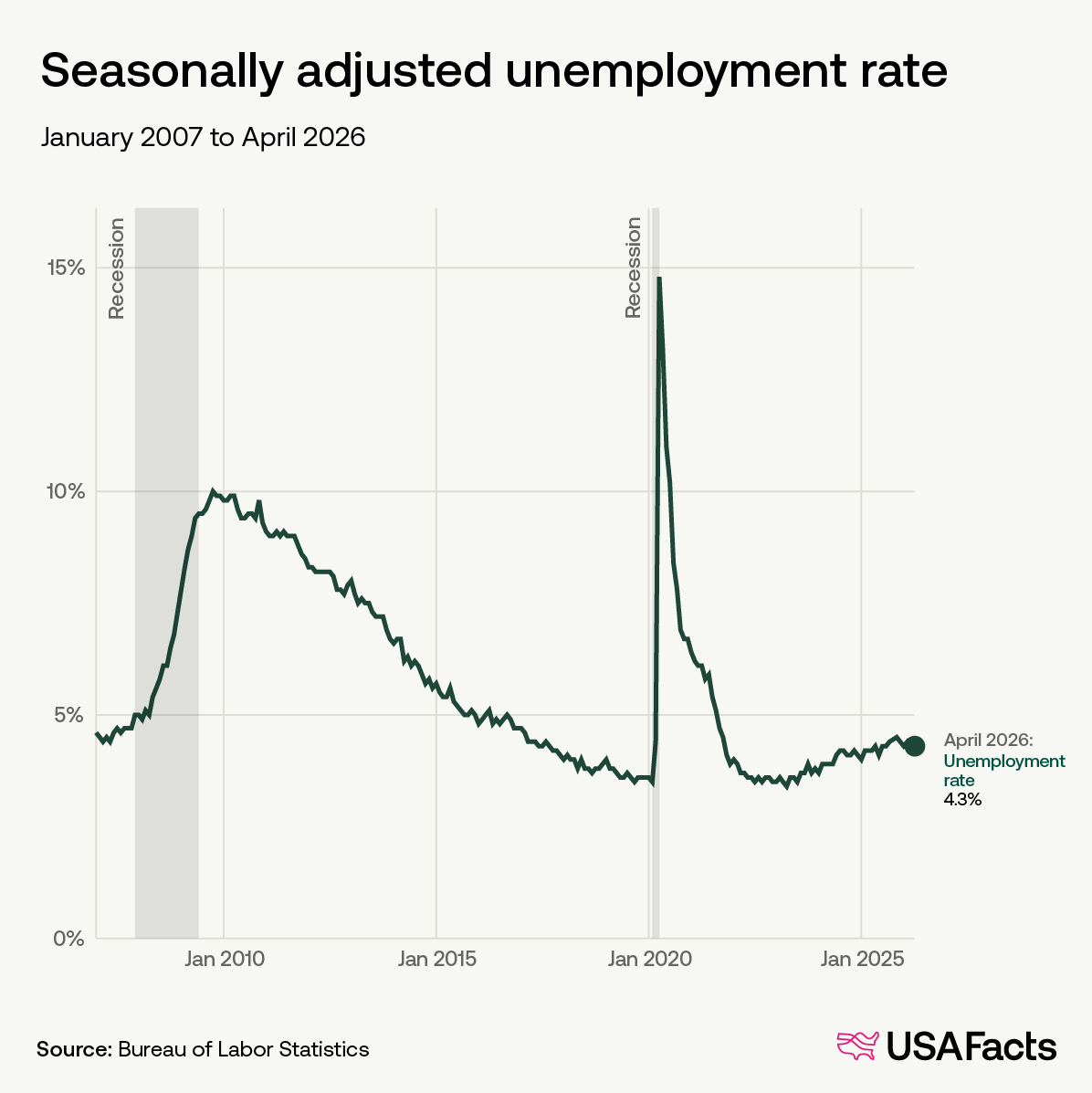
  • When the Fed raises interest rates, it can lead to the economy running “cold,” making things more expensive and slowing inflation. When borrowing is hard, it can slow the economy and drive up unemployment.  
How the Fed influences interest rates
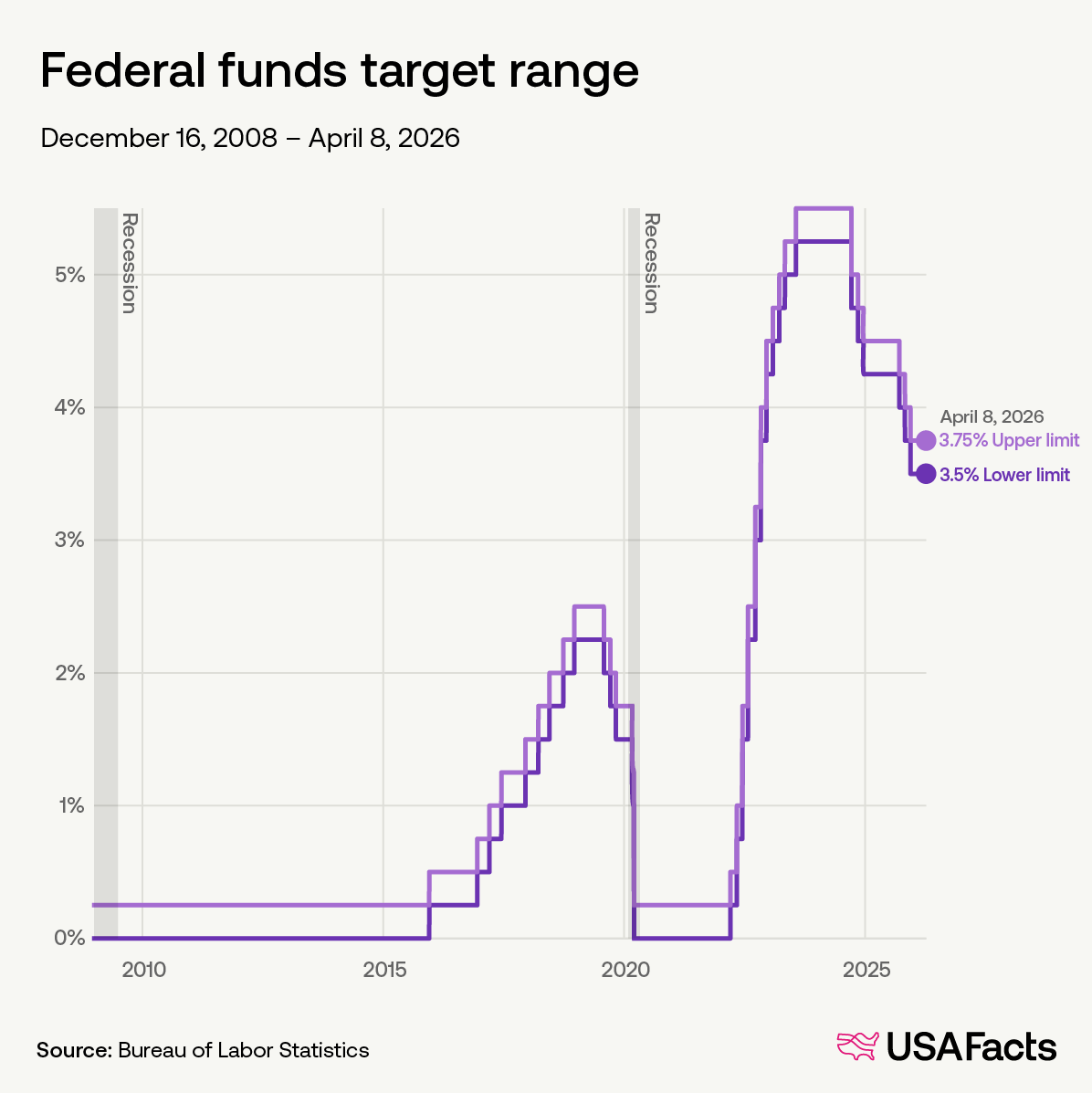
  • The Fed changes the interest it charges on loans it gives and pays on other banks' cash reserves it holds, effectively setting the limits at which other banks can charge interest. The average overnight rate at which banks transact is called the federal funds rate. Get a jargon-free explanation of the federal funds rate from Steve himself.
  • If the Fed raises the federal funds range, your bank’s costs go up. Your bank might raise interest rates on new loans. Mortgages, car loans, credit cards, and short-term business loans all get more expensive. That can ripple across the economy: people buy less, inflation can decrease as demand falls, less demand means companies may need fewer workers — causing unemployment to rise.

  • The federal funds rate target range has changed about 30 times in the last 10 years. In 2022, inflation climbed well above the Fed’s 2% goal. In response, the Fed raised the federal funds target range seven times in a single year. 
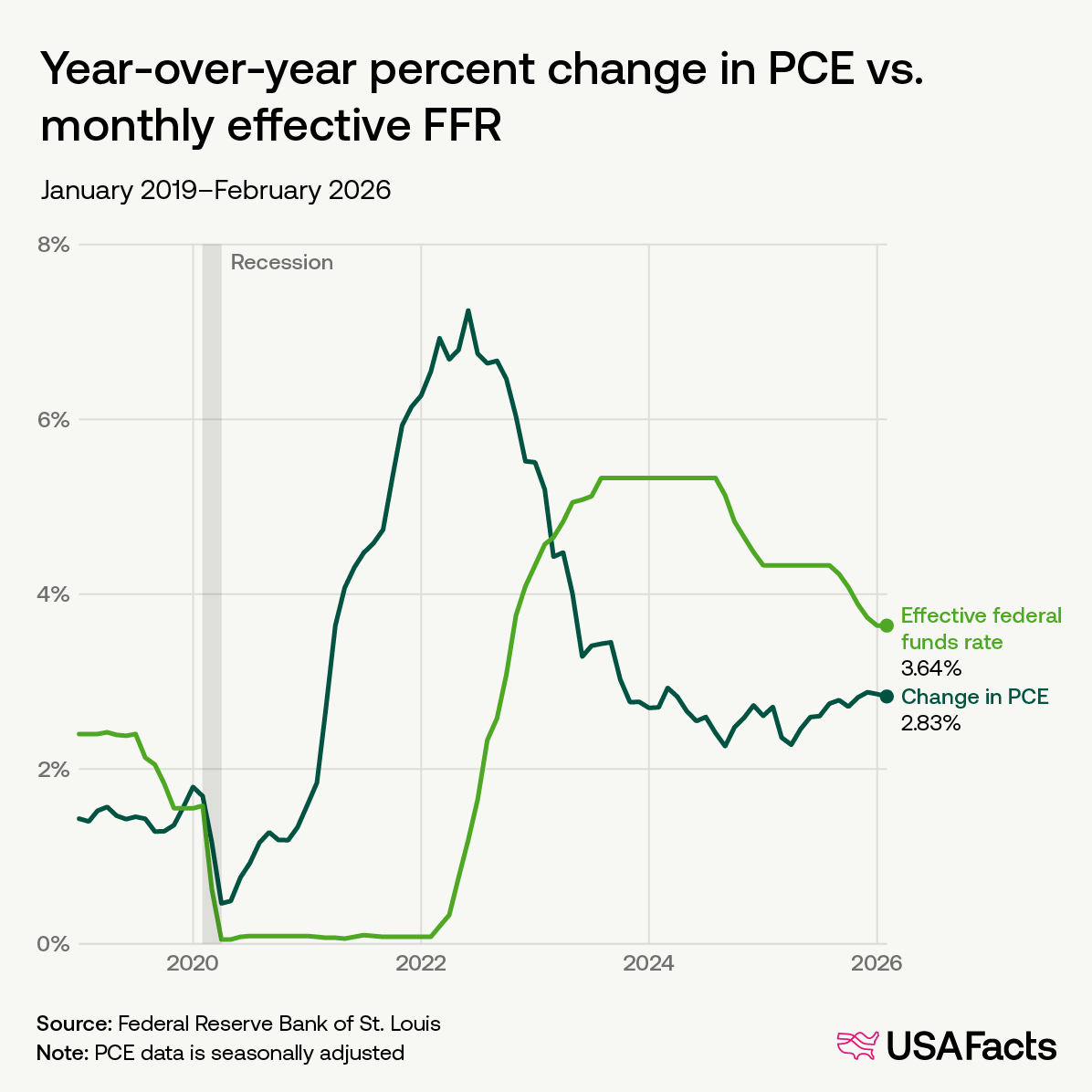
  • The Fed uses the Personal Consumption Expenditures Price Index (PCE) to measure inflation. The PCE tracks changes in the prices consumers pay across the economy. This differs somewhat from the CPI (the inflation measure most Americans are familiar with) because the two indexes use different methods and baskets of goods and services to calculate price changes.

  • Sometimes interest rate changes aren't enough, so the Fed uses other tools. One of them is to create money. (Sounds nice, right?) Here’s how
 
Thank you for joining us for this first Spotlight email! Watch the video now, then learn more about the Federal Reserve

Last Time an El Niño Was This Bad, It Killed 50 Million People

Last Time an El Niño Was This Bad, It Killed 50 Million People


Last Time an El Niño Was This Bad, It Killed 50 Million People
"It was arguably the worst environmental disaster to ever befall humanity."


By Joe Wilkins


Published May 14, 2026 8:57 AM EDT
Add Futurism(opens in a new tab)More information


Getty / Futurism


Sign up to see the future, today


Can’t-miss innovations from the bleeding edge of science and tech
Email addressSign Up


As if oil shortages, perpetual wars, and the existential angst of AI weren’t stressful enough, there’s an El Niño brewing — and it’s looking like it’ll be one of the most severe in over a century.

According to numerous weather models, this year’s El Niño — a prolonged climate event featuring unusually warm temperatures, which pops up every couple of years — could easily be the most severe we’ve ever experienced in the modern age. This year’s warm spell could supercharge ocean temperatures by as much as 5.4 degrees Fahrenheit, the Wall Street Journal reports, resulting in widespread droughts for some, floods for others, and perhaps most chillingly, chaos for global food supplies.

To find a historical equivalent, scientists have had to reach all the way back to 1877, when a merciless El Niño unleashed death on a scale few events can rival. Per the WSJ, the catastrophe fueled ongoing droughts, culminating in a global famine that killed at least 50 million people, though some estimates peg the loss of life at an even more horrifying 60 million — around 3 percent on the total population on Earth at the time.

As climate researchers wrote in a 2018 study of the famine: “it was arguably the worst environmental disaster to ever befall humanity and one of the worst calamities of any sort in at least the last 150 years, with a loss of life comparable to the World Wars and the influenza epidemic of 1918/19.”

As humanity has developed, some have suggested that events like the 1877 El Niño represent a stress test of our progress, finding weak points in our political and economic systems. With widespread poverty and colonial immiseration fueling massive famines throughout the 1800s, it’s safe to say we failed our 19th century test.

While we’ve certainly come a long way since then, cynics have plenty of talking points. This year’s El Niño will be coming on the back of widespread droughts, a debilitated food supply chain, and years of record-breaking ocean temperatures, to give just a few pressing examples.

Whether 2026 becomes another chapter in this cycle of preventable devastation depends on how we use the technology, resources, and knowledge at our disposal. While it may be easy to wave away the calamity faced by our ancestors as a footnote in time, the future is never certain, and history doesn’t grade on a curve.

More on climate events: Earth Screams in Agony as Microplastics Found to Increase Global Warming

Largest AI Cheating Scandal in Ivy League History

Brown University Professor Horrified to Discover Largest AI Cheating Scandal in Ivy League History
"The empirical evidence of fraud is overwhelming."


By Victor Tangermann


Published Jun 30, 2026 2:54 PM EDT
Add Futurism(opens in a new tab)More information


Shutterstock / Futurism


Sign up to see the future, today


Can’t-miss innovations from the bleeding edge of science and tech
Email addressSign Up

Award winning economist and Brown University professor Roberto Serrano says he has detected what appears to be the largest AI cheating scandal in Ivy League history.

As Spanish newspaper El País reports, Serrano noticed red flags as soon as he looked at the scores of a March midterm exam for one of the classes he teaches, an advanced undergrad course in mathematical economics.

The take-home and closed-book exam — an “Honor Code” type of test Ivy League schools are known for — resulted in 40 out of 86 students scoring a perfect 100. The average score was an equally questionable 96 out of 100.

In other words, it’s not a stretch to assume students gave in to the temptation to ask an AI chatbot for answers, particularly in the confines of their own homes without a teaching assistant looking over their shoulder. In Serrano’s testing, that appeared to be the case.

“Some answers contained unusual passages that coincided with results obtained after running the questions through ChatGPT,” Serrano told El País.

Perhaps most tellingly, the average score of an in-person final, which accounted for half of the final grade of the class, was an abysmal 48 out of 100. Of the 27 students who didn’t even bother to show up for the test, 22 had scored a 100 during the midterm exam, providing plenty of credence to Serrano’s theory.

“The empirical evidence of fraud is overwhelming,” he told the paper.

The incident highlights just how pervasive the use of AI has become in the classroom. Even students at highly reputable Ivy League schools are resorting to the tools to cheaply score high grades — even when doing so directly contradicts an honor code they all swore to uphold.

Compounding the concerning development, literacy and numeracy rates have taken a major hit over the last couple of years. College professors warn that we’re hitting a crisis point as incoming students barely have a middle-school level understanding of math and other subjects.

Some professors are lamenting that they’ve quickly become “plagiarism cops,” whose main job it is to root out AI-facilitated cheating instead of actually teaching. It’s a cat-and-mouse game greatly complicated by rapidly improving tech that’s making cheating harder to spot.

At the same time, experts warn that the use of the tools is destroying their students’ ability to think critically as they become hopelessly dependent on the tech.

It shouldn’t come as a surprise that Serrano has decided to stop giving take-home exams altogether.

A similar story is playing out at other Ivy League schools. As The Atlantic reported last month, Princeton recently stopped a 133-year-old “Honor Code” tradition involving professors leaving the room when students, who sign a pledge not to cheat, take their final exams.

Thanks to the dramatic uptick of AI use and academic dishonesty in the classroom, Princeton did away with the tradition altogether.

“There’s an air of people cheating on take-homes and people just using ChatGPT,” Princeton senior and former chair of the Honor Committee Nadia Makuc told The Atlantic. “As long as people think there is more cheating, it encourages more cheating.”

Beyond the loss of integrity, AI cheating is eroding the trust between students and educators, while the latter worry about the deteriorating value of a college degree.

“If we no longer defend truth and decency and honesty, then what kind of credibility are we going to have as academics?” Serrano told El País.

More on AI cheating: Princeton in Shambles Over AI Cheating

I Used to Work in Yosemite. No Reservation Rules

I Used to Work in Yosemite. This Is What the New No-Reservation Rules Really Do to the Park.


Outside Online · 4 hours ago
by awise · National Parks


On Saturday, May 2, I was walking through Camp 4 overflow parking lot in Yosemite National Park when my phone rang. “I just got ice cream, and I’m heading to El Cap Meadow to hang,” my friend Katy said. “Want to meet me there?”

I told her yes, but I’d be taking the bus. There was no chance in hell I’d drive my car and risk losing my parking spot.

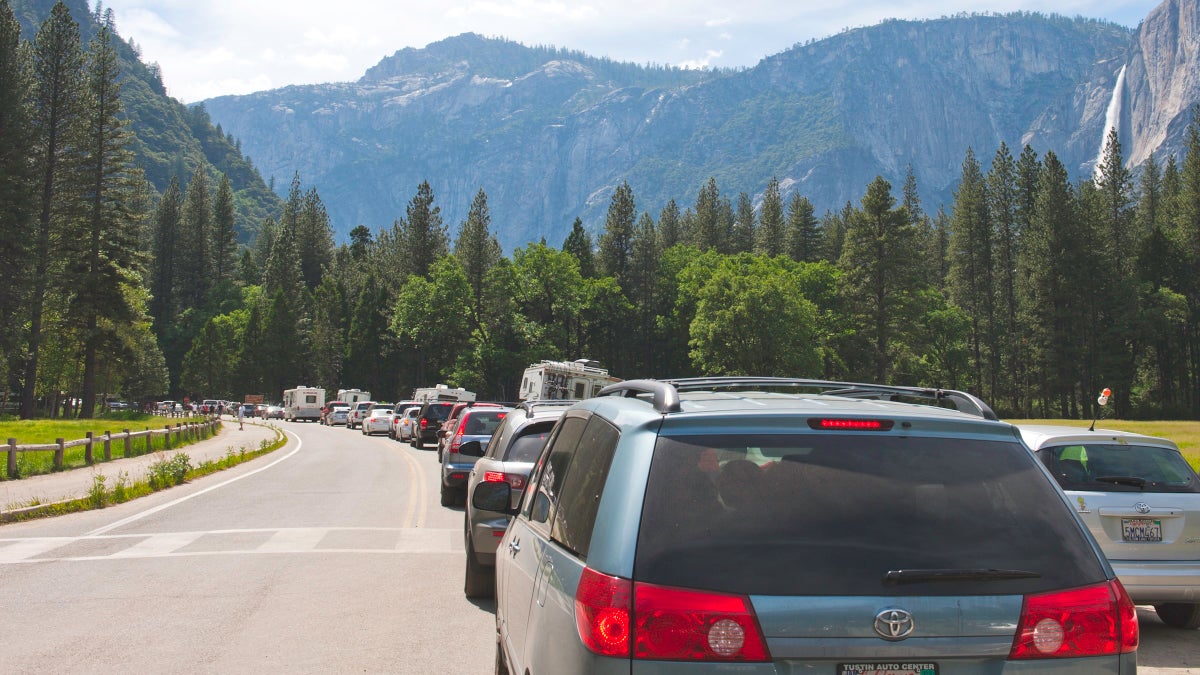
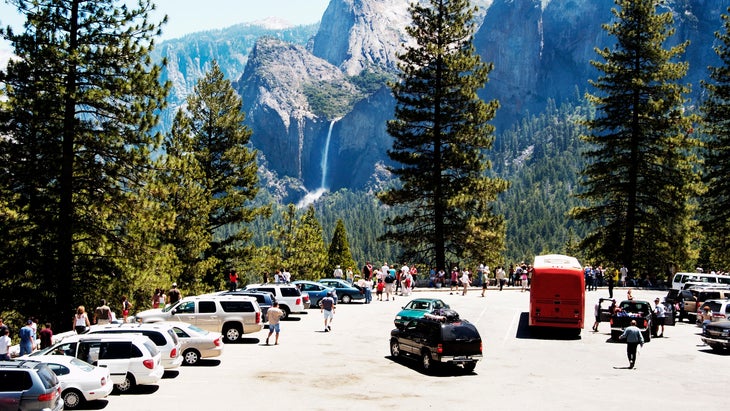
Yosemite’s parking lots that day, the first major weekend of a nervously anticipated season with no entry limits, could reasonably be described as apocalyptic. Cars squeezed between trees and rocks, onto curbs, and into the dirt on both sides of the road. On my 500-foot walk to the Lodge shuttle stop, five separate drivers flagged me down to ask if I was leaving the lot.

“Sorry!” I replied.

As I moved through the lot, the situation only got worse. The shuttle itself was trapped by an illegally parked car, which was being loaded onto a tow truck by the time I got in line. I counted two more tow trucks in the same lot, removing cars that were parked at odd angles. When I finally stepped onto the bus, I took a window seat and gaped at the line of cars parked along the roadside. It extended for the entire 1.8-mile stretch from Camp 4 to the El Cap picnic area.

Parking along this road is illegal, and every single driver was breaking the rules.

“This is crazy,” I told my partner. I couldn’t help but pity the hundreds of tourists who were getting ticketed, towed, or trapped on the road. What’s the point of driving all the way here if you can’t even get out of your car?Yosemite Valley overlook (Photo: photosbyjim / Getty)
Ditching Reservations Opens the Door for Crowds

For the past five years, Yosemite officials have conducted a careful set of experiments with a timed-entry reservation system, only to find its conclusions overridden by a federal order. Back in 2019, the park experienced 4.42 million visitors, its highest number since records began in 1906. In 2020, after the park shut down for three months, administrators introduced the first iteration of the reservation system in order to contain the spread of COVID-19. Day-use reservations were required for the majority of visitors. Anyone who didn’t book lodging in advance, enter via public transit, or have a wilderness or Half Dome permit needed a reservation. This continued throughout 2020 and 2021, shifting in 2022 to a “peak hours” reservation system for entrants between 6 A.M. and 4 P.M. each day.

Then, in 2023, Yosemite temporarily halted reservations, with an exception for the last three weekends of February, when the park usually gets slammed for Firefall. But doing away with the system had consequences. According to a 224-page NPS report on park visitation, the 2023 season saw “long lines at entrance stations and increased strain on the park’s employees, resources, and infrastructure.”

“I was here in 2023, and it was a shit show,” said one employee of the concessionaire Aramark, which oversees hospitality and food service in the park. The employee requested anonymity because they were not authorized to speak to the media. A survey conducted in 2023 found that 51 percent of visitors said they were negatively affected by parking shortages. An additional 26 percent said that crowding at restrooms and visitor centers negatively impacted their visit.

Having presumably learned their lesson in 2023, NPS officials brought back entry limits in 2024 and 2025 in a more limited, precise form: reservations would be required every day in the busy summer period, but only on weekends in the spring and fall. In August 2024, the park released a 224-page draft management plan that outlined and compared four different reservation systems, concluding that a parkwide reservation requirement during peak hours (5 A.M to 4 P.M.) would be the best option for managing the crowds. Already, the numbers were ticking up; 2025 saw 4.27 million visitors for Yosemite, nearly as many as before COVID-19.

In 2024, I worked in Yosemite as a Climber Steward, a position managed by the park’s nonprofit, Yosemite Conservancy, that offers advice and guidance to climbers. I came back to visit in June 2025, and both times, often drove between the park’s most crowded areas: Yosemite Village, Yosemite Lodge, Camp 4, and El Cap Meadow. Although lines were sometimes long, and I occasionally had trouble finding parking, I was never seriously delayed or hampered by the crowds. It seemed that Yosemite finally had its ideal rules to manage visitation capacity.

However, on April 3, 2025, Interior Secretary Doug Burgam ordered all national parks to remain “open and accessible.” Following that, on February 18, 2026, Yosemite Superintendent Ray McPadden announced that the NPS would do away with reservations in 2026. A March 2026 survey by the Yosemite Union showed that 85 percent of the 135 verified employee responses did not approve of Superintendent McPadden’s decision, predicting that no entry limit would lead to angry, disappointed, and exasperated guests who take out their frustrations on frontline workers. As of now, more than 300 staff members have publicly called for this decision to be reversed.
What to Expect

This spring, I returned to Yosemite to report on climbing for Outside’s sister publication, Climbing. Since the season’s opening, on Saturdays, I have seen the same clogged parking lots, miles-long entrance lines, and illegally parked cars that I saw on May 2. However, as summer approaches—and as monthly visitation nearly doubles between May and July—employees are steeling themselves for an unwinnable battle. In early May, one staff member in concessions told me that they predict the traditional Saturday crowding to become an everyday situation in June.

“Really?” I asked the worker, astounded. “Every single day?”

They nodded with a grim expression, the same I’d seen on every other Yosemite worker I’d asked about this topic: on guard and tired already.

Tourists are also feeling the impact of an unrestricted entrance policy. One visiting rock climber told me that the few restaurants in the park are overwhelmed by the crowds. During a recent trip to Curry Village, a collection of shops, lodges, and eateries near Half Dome, he saw hundreds of people waiting in line to get into the two restaurants. “I just got off Half Dome and went to Curry [Village] for a chill pizza moment,” he told me. “There were lines out the door everywhere; it was a total junk show. I had never seen this many people in my life.”
How to Visit Yosemite and Beat the Crowds

Amid the crowding and congestion, many readers may be planning to visit Yosemite National Park this summer. The good news is that, with some careful planning, you can sidestep the congestion. Here are four tips to hopefully save you some headaches during your visit.
1. Avoid Weekends, Especially Saturdays

Currently, Saturday is the only day when parking in Yosemite feels downright impossible. However, this will likely expand to Sunday, Friday, and beyond as the summer crowds draw nearer. For now, scheduling your visit from Monday to Thursday will give you the best chance of avoiding long entrance lines and full parking lots.

If you absolutely have to visit on a busy day, such as a Saturday or the upcoming Memorial Day weekend, it’s ideal to get to the entrance station in the early mornings (before 5 A.M.) or evenings (after 7 P.M.). You’re much better off getting an early start, entering without fuss, and finding a cool spot to nap by the river than being stuck for miles in a never-ending line.
2. Ditch Your Car for Public Transit

YARTS runs a bus service that splits from Yosemite Village in all directions: north to Sonora, west to Merced, south to Fresno, and east to Mammoth Lakes. Tickets run around $20 per person, and guess what? You won’t have to worry about parking at all.

Once you’re in the park, the Yosemite shuttle is free, although it only runs until 10 P.M. If you plan to be out after that, plan for a nice summer walk back to your camp spot.
3. Bring or Rent a Bike

If you have to put yourself through Yosemite’s parking hell, don’t make yourself do it more than once. Bring your own bike—I bought mine for $98 at Walmart, and you can get secondhand bikes for half that price on Facebook Marketplace—and get ready to hit all of Yosemite’s best tourist spots within just 10 to 15 minutes. Most of the Valley, especially the east side, features paved bike paths that pass under gorgeous redwood canopies. Honestly, biking is the most thrilling way to travel around Yosemite, even when it’s not crowded.

No bike, and no time to buy one? Yosemite offers daily bike rentals and helmets at the Lodge, Curry Village, and next to the Village Store, but beware: These can sell out within the first hour of the day, especially on weekends. A full day can cost up to $48, and all bikes must be returned by 6:45 P.M. Still, this beats spending most of your day looking for parking.
4. Pack Your Own Food

Some of the longest lines are at Yosemite’s few restaurants, especially during midday and after 5 P.M. To avoid this, it’s best to plan ahead and eat at camp or around the park. Instead of standing in line with a pager at Curry’s Pizza Deck, head to the Village Store early to grab your snacks. If they’re pre-cooked, stuff some utensils and blankets into your backpack and bike over to a lovely meadow or riverbank to enjoy it. If they need a proper grill, head back to your campsite and enjoy a group meal under the redwoods. Just make sure to observe proper Yosemite food storage, keeping it always in a bear box when you’re not around.

The post I Used to Work in Yosemite. This Is What the New No-Reservation Rules Really Do to the Park. appeared first on Outside Online.

New Haskell Library and Opera House Canadian entrance

New Haskell Library and Opera House Canadian entrance


Sherbrooke Record · 7 days ago
by Matthew Mccully · Community Interest

Record Staff (HB)

The Haskell Library and Opera House Board of Trustees is officially opening a brand-new Canadian entrance. This historic addition ensures uninterrupted access for Canadian patrons to the only library and opera house in the world deliberately built straddling an international border.

This construction follows an unexpected decision by U.S. authorities in March 2025, which restricted traditional Canadian access through the building’s historic main entrance.

For over a century, patrons from both countries entered through the same door without going through official border crossings. The new entrance preserves the institution’s founding mission: to serve as a shared cultural hub where borders disappear.

The opening ceremony for the new entrance will be on June 10, 2026 at 11a.m. at the location (1 Church Street, Stanstead), according to a press release from the Haskell. The inauguration is open to patrons, donors, the general public, media, and government representatives from both countries.

The Haskell structure has stood as a monument to international peace and community unity since 1904. While the events of 2025 presented an unprecedented challenge, the completion of this Canadian entrance is a testament to the unwavering commitment to the house’s patrons. The ribbon-cutting ceremony will include short speeches from board members and community leaders. It will be followed by a reception and guided tours of the facility.

Please subscribe to read more news like this, published every Friday

L’article New Haskell Library and Opera House Canadian entrance est apparu en premier sur Sherbrooke Record.

The most AI-obsessed companies spend $7,500 per employee per month


The most AI-obsessed companies spend $7,500 per employee per month. The median spends $11.
feed favicon
The Next Web · 18 hours ago
by Cristian Dina · Artificial Intelligence
image

The top 1% of US companies by AI adoption spend $7,500 per employee per month on AI tools and compute. The median firm spends $11.38. That 680x gap, drawn from the Ramp AI Index, is the clearest picture yet of how unevenly AI spending is distributed across American business. Ramp describes the top 1% as […]


This story continues at The Next Web

The biggest scandal in college sports is brought to you by a Texas judge


The biggest scandal in college sports is brought to you by a Texas judge

MS NOW · 16 hours ago
by Keith Reed · Opinion


If there were anything like justice in college sports, Brendan Sorsby would never play another down of football. It’s a tough thing to say about someone only 22 years old, and under most circumstances, I’d never argue that misdeeds should end an athlete’s career before they hit the professional ranks.

But Sorsby, Texas Tech’s star quarterback, isn’t an average college kid who made a mistake. He bet at least $90,000 on sports — including on games involving the Indiana Hoosiers when he was on that team’s roster as a freshman in 2022. For obvious reasons, the NCAA frowns upon such behavior and rightly issued a permanent ban when it discovered what Sorsby did. Sorsby says he’s been diagnosed with a gambling addiction.


Sorsby says he’s been diagnosed with a gambling addiction.

But on Monday, retired Texas judge Ken Curry, appointed to the case after another judge recused himself, gave Sorsby a pass with a temporary injunction that will allow him to play this season. Curry reasoned that the injunction was necessary to avoid “probable, imminent and irreparable injury” to the quarterback’s college football career. But the judge is mischaracterizing the consequences of Sorsby’s actions as injury.

Those who have watched college football scandals over the decades should be especially incensed by the judge’s ruling that Sorsby should play. His transgressions are exponentially worse than those of Reggie Bush, who was forced to forfeit his Heisman Trophy in 2010 for rules violations he allegedly committed while at the University of Southern California, and exponentially worse than Ohio State University’s Terrelle Pryor, who was suspended for receiving free tattoos and selling his memorabilia. Granted, those punishments were imposed in a bygone era when the NCAA still stood on the farce that players, the labor in its multibillion-dollar enterprise, were amateurs and all but forced them to the black market to profit from their work.

Those infractions from Bush and Pryor were metaphorical misdemeanors relative to the near-treasonous offense Sorsby committed against the NCAA. The integrity of the games, or at least the appearance thereof, are crucial for the association’s survival. Thus, its strict prohibition against gambling and its promise of a kind of death penalty (a lifetime ban) for athletes who gamble anyway.
Play 
Online sports betting for some is a near-fatal gamble: Report October 27, 2025 / 07:54

Sorsby acknowledged a gambling addiction, a serious mental health issue that warrants professional treatment, and to his credit, he reports that he recently sought a 35-day rehab at an inpatient clinic in Arizona. Gambling addiction can cause immense harm to the afflicted and those around them. It’s also a compulsion whose victims often relapse, which isn’t something someone in Sorsby’s position can afford, even once.

It’s not something the NCAA can afford, either. In this instance, the NCAA saw a problem — the starting quarterback at a Power Conference school has a gambling problem that makes him vulnerable to compromise — and it took that problem out at the knees. Sorsby, who is discussed as a rising NFL prospect, had every right to try to enter the league’s supplemental draft or to seek a free agent tryout. Obviously, any NFL general manager with common sense would think long and hard before adding him to the roster, which means he’d be risking not being able to play in college or the pros. But such are the wages of his sin. The predicament he put himself in doesn’t warrant the judge forcing the NCAA to let him play after he flouted its rules and violated the integrity of its sport.

To the extent that he’s seriously contrite, Sorsby deserves credit for taking accountability, which he did in a social media post last month. But contrition doesn’t erase consequences, and accountability often demands them. Yet here we have a judge forcing the NCAA to let Sorsby play alongside other young men who have every right to question their teammate’s motives. Other college programs have responded by vowing not to play any games against Texas Tech.

Sorsby embodies two overlapping problems involving sports and gambling: the increasing prevalence of gambling addiction among young adults, teenagers and even preteens and the seemingly growing number of instances of athletes themselves betting on games. Just last week, an arbitrator ruled that NBA free agent Terry Rozier must forfeit most of his $26.6 million salary for the 2025-26 season after he was alleged to have taken a bribe to withdraw from a game early when he was playing for the Charlotte Hornets. Rozier has pleaded not guilty to the gambling accusations.

If Sorsby ever makes it to the NFL, one wonders how he will fare in a league that prohibits its players from gambling but has rich partnership deals with FanDuel, DraftKings and Caesars Entertainment, its “official casino sponsor.” In the pros, nobody even pretends there’s a wall between the action on the field and the action the sportsbooks are taking in real time. Fans will be in the stadium, not just watching but placing bets. Whichever team signs Sorsby would be gambling too: that he won’t repeat the same offenses that put the NCAA and Texas Tech in a negative spotlight.


The post The biggest scandal in college sports is brought to you by a Texas judge appeared first on MS NOW.

NOAA Issues Stark Warning About Upcoming El Niño Beware.

NOAA Issues Stark Warning About Upcoming El Niño
Beware.


By Frank Landymore


Published May 20, 2026 1:22 PM EDT
Add Futurism(opens in a new tab)More information


Getty / Futurism

Sign up to see the future, today

Can’t-miss innovations from the bleeding edge of science and tech
Email addressSign Up


It’s never a good sign when meteorologists start throwing around phrases like “double whammy.” But that’s what scientists at the National Oceanic and Atmospheric Association say we’re in for with the return of El Niño, the fearsome tropical climate pattern.

In a new announcement, NOAA’s National Weather Service said that it was predicting El Niño will likely emerge in July and last through the winter, bringing high-tide flooding with it. These floods can happen without storms or heavy rainfall; as El Niño causes flux in the jet streams above the ocean, these can elevate local sea levels along the coasts and spill over onto land.

William Sweet, a NOAA oceanographer and high tide flooding expert, warns that these events often end up being a “double whammy,” amid a backdrop of climate change.

“The first punch is decades of sea level rise, which has waters close to the brim in many coastal communities,” Sweet explained in a statement. “And now with this second punch — a strong El Niño — coastal communities face more frequent, deeper and widespread high tide flooding along both the West and East Coasts.”

El Niño is part of a cyclical climate phenomenon caused by shifting winds and surface temperatures over the ocean. In the phenomenon’s warm phase, the planet’s easterly winds along the equator, called trade winds, weaken and migrate upward, warming the northern oceans. In its cool phase, El Niña, the opposite happens: the trade winds get stronger and cool the Pacific off the western Americas and drive warmer waters towards Asia. It swings between warm and cool phases every two to seven years on an irregular schedule, wreaking varying degrees of devastation.

This year, unfortunately, is anticipated to be historically disastrous. Scientists are projecting that El Niño will heat sea surface temperatures in the eastern tropical Pacific by 5.4 degrees Fahrenheit. Experts say a similar shift happened during the strongest El Niño on record in 1877 to 1878, which drove a global famine that killed more than 50 million people worldwide.

While the food supply chains are more robust than it was 150 years ago — or so you’d hope — that figure gives you an idea of how disruptive a few degrees’ difference in ocean temperatures can be. Batten down the hatches, folks.

More on the climate: The Upcoming El Niño Is About to Unleash Devastation, Experts Warn


Frank Landymore
Contributing Writer


I’m a tech and science correspondent for Futurism, where I’m particularly interested in astrophysics, the business and ethics of artificial intelligence and automation, and the environment.

Clive Davis, Legendary Music Executive, Dies at 94


Clive Davis, Legendary Music Executive Who Signed Bruce Springsteen and Whitney Houston, Dies at 94

PEOPLE confirmed news of his death with his longtime spokesperson on Monday, June 22
By
Ilana Kaplan,
Sarah Michaud,
Sarah Michaud
Sarah Michaud is the senior news editor of PEOPLE's music vertical. She has been working at PEOPLE for 18 years.
PEOPLE EDITORIAL GUIDELINES
and
Alexandra Schonfeld
Updated on June 22, 2026 04:06PM EDT
94COMMENTS

NEED TO KNOW
Clive Davis, five-time Grammy winner and legendary music executive, has died at 94
During his decades-long career in music, Davis helped helped launch Janis Joplin, Bruce Springsteen, Whitney Houston and Alicia Keys to superstardom
Known as the "man with the golden ears," he kept working into his 90s after being appointed the chief creative officer for all of Sony Music Entertainment in 2008

Legendary music executive and producer Clive Davis has died. He was 94.

In a statement shared with PEOPLE, Davis' longtime rep Aliza Rabinoff said that he "passed away peacefully from age-related illness at the age of 94 at his home in Manhattan on Monday, June 22, surrounded by his family and loved ones."

The New York Times was first to report the news.

Davis had recently been hospitalized in New York City on May 29, and was discharged on June 4. A spokesperson told PEOPLE at the time that he was "in good spirits and happy to be recuperating at home."

In a statement following his death, Davis' family said, "To the world, our father was the iconic music legend whose vision, instincts, and relentless pursuit of excellence shaped the soundtrack of countless lives. He discovered, mentored, and championed the greatest artists in modern music history, leaving an indelible mark on culture that will endure for generations. To his family, Clive was Dad and Granddaddy, the steady presence at the center of our lives, the source of wisdom, strength, encouragement, and unconditional love. No matter how extraordinary his professional accomplishments, he never lost sight of what mattered most: the people he loved."

They continued, "Through every chapter of his remarkable life, family remained Clive's greatest pride and deepest joy. Today, we celebrate not only a towering figure whose influence changed music forever, but the man who led our family with grace, generosity, and kindness. We will miss him greatly, cherish him always, and carry his love with us for the rest of our lives."
Clive Davis.

Fadil Berisha

In the past, Davis dealt with various health issues. His annual star-studded pre-Grammy Gala was postponed when he was diagnosed with Bell's palsy in 2021. According to the National Institute of Neurological Disorders and Stroke, the condition is an unexplained but treatable neurological disorder that causes paralysis or weakness on one side of the face.

The five-time Grammy winner held positions at several major music labels, including Columbia Records, RCA Music Group and BMG. He founded Arista Records in 1974 and served as its president until 2000 when he launched J Records. Known as the "man with the golden ears," Davis signed countless artists who went on to become some of the biggest names in music. In 2008, he was appointed chief creative officer for all of Sony Music Entertainment.

"Clive of course played a seminal role in the story of Sony Music through two incredible chapters, and he is responsible for a huge part of the recorded legacy of the company permanently," said Rob Stringer, Chairman, Sony Music Group in a statement.

"Not only are many, many artists we represent continuously indebted to his service but so many staff members have been influenced and mentored by his deep love and respect for our company which he carried right up until today. Our working lives are better for having had his constant presence in the aura and perception of Sony Music."
Clive Davis (left) and Sly Stone in the 1970s.Michael Ochs Archives/Getty Images

RELATED STORIES
Look Back at Music Executive Legend Clive Davis' Remarkable Career and Life in Photos
All About Clive Davis’ 4 Kids, Fred, Lauren, Mitchell and Doug


Born on April 4, 1932, Davis was raised in the Crown Heights neighborhood of Brooklyn. He earned a scholarship to NYU and later Harvard Law School: "I didn’t have money to go to school without scholarships," he told PEOPLE in 2022.

"I was your basic, garden-variety, ambitious, upwardly mobile, hard-working Jewish boy from Brooklyn," he wrote in his autobiography, per Vanity Fair. His parents died within a year of each other while he was a student at NYU, the outlet reported.

He became the president of Columbia Records in 1967 after first working as the company's general counsel and went on to sign artists including Janis Joplin, Billy Joel, Bruce Springsteen, Aerosmith, The Isley Brothers and Earth, Wind & Fire. Things took a turn in 1973 when he was fired from the company amid allegations of misusing funds — which he denied.

"That was obviously a traumatic period. One's life doesn't go up, up and up," he said during a talk at 92NY in 2013, adding, "There was someone in the company that was fraudulently signing invoices [and] ended up going to jail. I never appointed him, he didn't report to me, but I delegated to him, and apart from hundreds of other invoices, he falsified two or three of my invoices, one of which has gotten publicity through the years as though I was trying to charge my son's bar mitzvah to the company — totally untrue."
Barry Manilow (left) and Clive Davis in 1978.Robin Platzer/Twin Images/Time Life Pictures/Getty

Davis said CBS — which owned Columbia Records — knew the allegations were false, but when the perpetrator was indicted and claimed there was payola going on "in the industry and throughout Columbia Records," Davis became a "sacrificial lamb."

He faced financial strife during this time, Vanity Fair reported, and improved his finances with a contract to write the 1975 autobiography Clive: Inside the Record Business.

The year after he was fired by CBS, in November 1974, he started Arista Records with Columbia Pictures. Over the next three decades at his new label, he kicked off the careers of music greats including Barry Manilow, Patti Smith, Whitney Houston, Alan Jackson and more, while navigating big comebacks for Dionne Warwick, Aretha Franklin and Carlos Santana.

"When I started Arista, I was no longer heading the number one label in the industry. It was a brand-new company, starting from scratch. I was hungry to be a major label. I needed multi-platinum, and the only way to get to be multi-platinum is with hit songs," he told PEOPLE in 2022. "I didn't have to wait long because the first record on Arista was 'Mandy.' I gave it to Barry Manilow. It went to No. 1."

Clive Davis (left) and Bruce Springsteen in 2017.Clive Davis/Instagram

He helped to form LaFace Records in 1989 with L.A. Reid and Babyface and signed artists like TLC, Toni Braxton and Pink. In 1994, he teamed up with a then-relatively unknown Sean Combs for a 50/50 joint venture that led to the creation of Bad Boy Records, one of the most successful hip-hop/rap labels of the decade. Its roster included the Notorious B.I.G., Faith Evans, Mase, 112 and Combs himself.

In 2000, Davis was inducted into the Rock and Roll Hall of Fame as the only non-performer at the time. That same year, he announced the formation of J Records, which signed artists including Alicia Keys, who was on hand to sing a special version of "Happy Birthday" at Davis' 90th birthday gala in 2022.

"It was one of the greatest, if not the greatest night of my life," he told PEOPLE of the party.

Clive Davis at the Apollo Theater Spring Benefit in New York City in June 2025.

Shahar Azran/Getty


After splitting from his second wife in 1985, Davis "opened myself up to the possibility of a relationship with a man," he told PEOPLE. The father of four revealed in his 2013 memoir The Soundtrack of My Life that he was bisexual and that he was in a relationship with a man at the time. In the book, he said those closest to him knew about his sexual orientation. He wanted to share it with the world because, he told PEOPLE, "This is the story of my life. I knew I was going to include that important part of it."

Davis, who was honored by philanthropic organizations such as the T.J. Martell Foundation, the Anti-Defamation League and the American Cancer Society, gave a $5 million gift to the Tisch School of the Arts at New York University for the creation of a new department.

The Clive Davis Institute of Recorded Music was the first and only program of its kind providing education for future music industry leaders.

Davis is survived by his four children — sons Doug, Mitchell and Fred Davis and daughter Lauren — eight grandchildren Austin, Charlie, Matthew, Hayley, Harper, Sloane, Billie and Cody, two great grandchildren, his cousin Jo Schuman and his longtime partner Greg Schriefer.

Kristi Noem hired in strategic advisory role for B.C. mining company - just stinks

 Kristi Noem hired in strategic advisory role for B.C. mining company


By Amy Judd Global News
Posted June 16, 2026 7:54 pm

2 min read


Former U.S. secretary of homeland security and current special envoy to the Shield of the Americas, Kristi L. Noem, has been hired by a British Columbia mineral exploration company.
LEAVE A COMMENTSHARE THIS ITEM ON FACEBOOKSHARE THIS ITEM VIA WHATSAPPSEND THIS PAGE TO SOMEONE VIA EMAILSEE MORE SHARING OPTIONS

DESCREASE ARTICLE FONT SIZE
INCREASE ARTICLE FONT SIZE

Former U.S. secretary of homeland security and current special envoy to the Shield of the Americas Kristi L. Noem has been hired by a British Columbia mineral exploration company.

In a release on its website, NovaRed Mining Inc., whose head office is located in Vancouver, said Noem has joined the company in a “strategic advisory role to support NovaRed’s mission of acquiring and advancing critical mineral exploration opportunities through its artificial intelligence-enhanced technology platform.”

In March, Noem was reassigned from her role as secretary of the Department of Homeland Security, after serving 13 months.

In a post on Truth Social, U.S. President Donald Trump said that Noem, “who has served us well, and has had numerous and spectacular results (especially on the Border!, will be moving to the new role of ‘Special Envoy for The Shield of the Americas.’”
STORY CONTINUES BELOW ADVERTISEMENT


9:40Krist Noem blames ‘violent’ protesters for Minneapolis chaos


Stick to the Facts

Add Global News as a Preferred Source on Google to see more of our stories in your search results.


Following the announcement, Noem thanked Trump for appointing her as the Special Envoy for the Shield of the Americas and said she looks forward to working with U.S. Secretary of State Marco Rubio and Defense Secretary Pete Hegseth.

Get breaking BC news
Get breaking BC news delivered to your inbox as it happens so you won't miss a trending story.SIGN UP FOR BREAKING BC NEWSLETTERGET STARTED
BY PROVIDING YOUR EMAIL ADDRESS, YOU HAVE READ AND AGREE TO GLOBAL NEWS' TERMS AND CONDITIONS AND PRIVACY POLICY.

“The Western Hemisphere is absolutely critical for U.S. security. In this new role, I will be able to build on the partnerships and national security expertise, I forged over the last 13 months as Secretary of Homeland Security,” Noem wrote.

Noem faced criticism while overseeing Trump’s immigration crackdown, including over the shooting deaths of two protesters — Renee Good and Alex Pretti — in Minneapolis at the hands of immigration enforcement officers. The former South Dakota governor was also criticized over the way her department has spent billions of dollars allocated to it by Congress.

Liar's Kingdom- a nation awash in lies

Liar's Kingdom- a nation awash in lies

Liar's Kingdom- a nation awash in lies
Our latest Main Justice episode, with audio AND video this week

Andrew Weissmann
May 20, 2026

There’s a pattern to our focus this week: lies, lies and more lies. Lots to cover, discuss, and dissect!

Mary and I were together in MS NOW’s NYC offices and on video this week. We tackle a host of issues and celebrate (briefly!) the release of my new book, Liar’s Kingdom. After digging into the book’s thesis, about how to prevent political lies — a topic that is sure timely! — we hone in on the biggest news of the week: the $1.776 billion “Anti-Weaponization Fund” created by the Justice Department as part of a claimed “settlement.” As Mary notes, it is built on a lie (get the theme this week?), with the real goal being to compensate Trump allies who claim they were wrongfully prosecuted by the former administration. And to give Trump and his sons a general release of liability. And to create a cadre of foot soldiers, who do not have to worry about legal liability and will be able to be compensated for their efforts.

We then shift to the DOJ’s lawsuit against the DC Bar to block punishments for DoJ

lawyers, including Jeffrey Clark, the former Acting Assistant Attorney General in the final months of Trump’s first term. This is such an important development to keep our eyes on as it is a pernicious attack on one of the last-standing checks on corrupt attorneys.

Next, we discuss last week’s oral arguments in the government’s appeal of four rulings against Trump’s unconstitutional attempts to blacklist four law firms It did not go well for the DOJ or Trump. (Full disclosure, one of the Trump executive orders prominently slammed me personally, but within days was found by the federal district judge in Washington to have violated my First Amendment rights and was struck down.)

Quite a week. And thank you all who have followed my comings and goings this week, talking with various folks about Liar’s Kingdom. A first review is out, which you can read HERE. If you want to order the book, including obtaining a signed copy or to hear me read the audio version, you can do so HERE.

Stay engaged, now more than ever.

Andrew

Nvidia CEO Begs Execs to Stop Telling Workers They’re Fired Because of AI

Nvidia CEO Begs Execs to Stop Telling Workers They’re Fired Because of AI


Futurism · 20 hours ago
by Victor Tangermann · Artificial Intelligence


We’ve long had our doubts about tech leaders making boisterous claims about automating jobs with AI.

For a while now, executives have raised eyebrows by justifying sweeping layoffs by arguing that AI had made thousands of roles redundant. But as reality settles in and the tech’s real-world capabilities are coming into focus, some in the industry are starting to sing a dramatically different tune.

Most recently, Nvidia CEO Jensen Huang scorned other executives for wrongly justifying layoffs with AI — and telling them to cut it out. The hidden implication: soaring costs are the real culprit, especially when it comes to AI-related spending, mismanagement, and over-hiring.

“The narrative that connects AI to job loss, for many of the CEOs that are doing it — it is just too lazy,” Huang told Channel News Asia. “AI has just arrived, how is it possible they’re already losing jobs?”

“How is it possible that AI became productive and useful only six months ago, and they were somehow laying people off two years ago because of AI?” he added. “It doesn’t make any sense.”

Huang didn’t beat around the bush in his searing comments.

“It was just a way for them to sound smart and I really hate that,” the CEO argued. “I think we’re scaring people, and that’s irresponsible.”

We’ve long suspected that CEOs have been trying to mislead investors by claiming that much human labor was simply no longer needed in the age of AI. In one particularly telling episode earlier this year, Twitter founder and Block Inc (formerly Square) CEO Jack Dorsey announced he was slashing his company’s workforce by “nearly half,” citing the emergence of “intelligence tools” that are “accelerating” changes.

Former staffers quickly threw cold water on his claims, arguing the layoffs were actually the result of over-hiring, particularly during the COVID-19 pandemic.

Instead of a dramatic rise in productivity, what’s far more likely is that companies are draining their pockets by making enormous investments in AI. That’s especially pertinent as the cost of accessing AI cloud computing resources continues to soar, forcing companies to slow down hiring.

To Huang, it’s the result of a lack of ambition, more than anything else. He also remains hopeful about AI ultimately leading to more jobs, not fewer.

“It’s more likely that the companies with ambition will be more productive, they will do things faster, their company will increase in velocity,” he told Channel News Asia. “As a result, they become larger, more profitable. When they become larger, more profitable, they’ll end up hiring more people.”

“Of course, they’ll use more AI, but they will also hire more people,” he added.

It’s a shift in messaging. Just last year, Huang warned in a CNN interview that “if the world runs out of ideas, then productivity gains translates to job loss” and that “everybody’s jobs will be affected” while “some jobs will be lost.”

Huang isn’t alone in dismissing AI layoffs. Just last week, Google DeepMind CEO Demis Hassabis accused leadership at other companies of a “lack of imagination” for blaming layoffs on AI.

In short, it’s a harsh reality check that flies in the face of ongoing narratives being pushed by executives desperately trying to convince investors that unprecedented levels of spending are justified.

“This is not a minor disagreement about messaging,” marketing publication State of Brand wrote. “This is the people selling the shovels telling the miners to stop blaming the shovels for the cave-in.”

More on Nvidia: Nvidia CEO Says AI Will Be a Permanent Micromanaging Boss Who Never Stops Nagging You

RG Richardson Communications News

I am a business economist with interests in international trade worldwide through politics, money and banking. Interactive Internet VoIP and secure eMail Communications. The author of RG Richardson City Guides has over 300 guides, including restaurants and finance.